
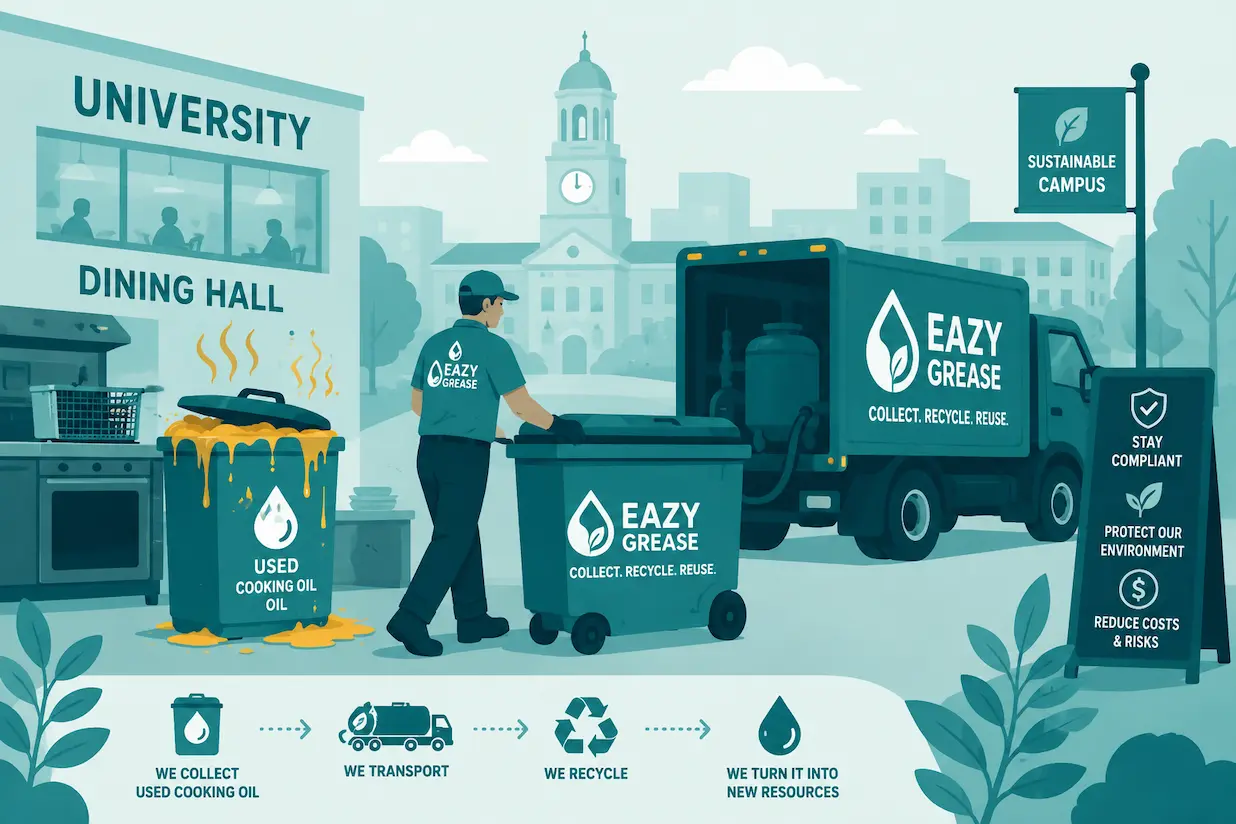
University dining halls operate at a scale that most independent restaurants never reach. A single large campus dining facility can serve thousands of meals per day across multiple kitchen stations, running commercial fryers continuously throughout breakfast, lunch, and dinner service. That volume translates into significant quantities of used cooking oil generated every week, and managing that oil correctly requires a structured, reliable collection and recycling program built specifically for the pace and complexity of campus operations.
This weekly used cooking oil pickup for university dining halls: a service guide covers everything campus food service managers need to know: how collection works, what questions to ask a provider, how grease traps fit into the broader FOG compliance picture, and how universities can turn their used cooking oil into a sustainability asset.
What Do Restaurants and Universities Do with Their Used Cooking Oil?
Used cooking oil, also known as yellow grease, is not waste in the traditional sense. It is a commodity with real market value that can generate revenue for universities based on the quality and volume of oil collected. The most common end use is conversion into biodiesel and renewable diesel, both of which reduce reliance on petroleum-based fuels and lower greenhouse gas emissions compared to conventional alternatives.
Recycling used cooking oil saves approximately 80,239 tons of CO2 emissions annually across the facilities that participate in structured collection programs. Universities that integrate cooking oil recycling with broader waste reduction initiatives are able to report measurable sustainability outcomes that support campus ESG goals, accreditation requirements, and student and community expectations around environmental stewardship.
Used fryer oil collected from university dining halls is generally managed separately from petroleum-based programs due to different recycling pathways. Yellow grease goes to rendering facilities or biodiesel producers, not to motor oil recyclers. This distinction matters when universities are setting up their collection programs and choosing vendors.
How Much Do Universities and Restaurants Get for Used Cooking Oil?
Used cooking oil is a commodity, and its value fluctuates with market conditions. Restaurants and universities generating consistent volumes of high-quality used fryer oil typically receive rebates from their collection provider rather than paying for disposal. Rebate rates generally range from $0.15 to $0.45 per gallon depending on oil quality, volume, and current yellow grease market prices.
Universities generate significant volumes of fryer oil, making recycling both environmentally and economically beneficial at scale. A large university dining operation producing several hundred gallons of used cooking oil per week can earn thousands of dollars annually in rebates, simply by partnering with a licensed collection service and maintaining oil quality between pickups.
Oil quality is the key variable. It is crucial to prevent contamination of cooking oil to maintain its recycling value. Oil contaminated with water, food solids, or other materials is downgraded at the processing facility and may incur surcharges rather than earning rebates. Cooling used oil completely before transferring it to storage containers, and keeping containers sealed between transfers, protects quality and protects rebate income.
Where Is the Best Place to Dispose of Used Cooking Oil?
The best place to dispose of used cooking oil is through a licensed cooking oil collection and recycling service that provides free containers, scheduled pickups, and documentation of every collection for compliance purposes. Used cooking oil should never be poured down the drain. FOG that enters the sewer system causes blockages, contributes to fatbergs, and can result in fines and enforcement action from municipal authorities.
Universities in regulated markets face additional scrutiny. Gainesville, Florida enforces strict grease rules for food service establishments under Chapter 27, Article IV of its municipal code. Virginia requires grease trap cleaning every 90 days as a baseline compliance requirement. Federal law requires a Spill Prevention, Control, and Countermeasure (SPCC) plan for any facility storing over 1,320 gallons of oil on-site. Proper UCO collection prevents overflows and ensures compliance with these local environmental regulations.
For university dining halls, the answer to where to dispose of used cooking oil is straightforward: a licensed vendor who collects on a schedule matched to your oil generation rate, provides proper documentation after every pickup, and recycles the oil into sustainable products rather than sending it to landfill.
How Do I Dispose of Used Cooking Oil Near Me?
University procurement teams looking for local used cooking oil collection and recycling services should search for licensed, insured vendors operating in their campus region. Coverage varies significantly by geography. Greasecycle, for example, serves 156 counties across three states and has recycled 23 million gallons of used cooking oil, making it a regional option for campuses in its coverage area. Mahoney Environmental is an EPA-approved recycler of used cooking oil with a national footprint. San Diego campuses have access to several licensed collectors serving Southern California’s dense food service market.
For East Coast university dining halls, Eazy Grease provides cooking oil collection and recycling service across Florida, Georgia, Alabama, Tennessee, South Carolina, North Carolina, Pennsylvania, Connecticut, New Jersey, and New York, with flexible scheduling, free containers, and digital compliance documentation at every pickup.
When evaluating any local provider, confirm that they are licensed and insured for waste oil transport in your state, that they provide a manifest or digital service record at every collection, and that they offer responsive service including emergency services for overflow situations between scheduled pickups.
Weekly and High-Frequency Collection: Why University Dining Halls Need It
Most restaurant cooking oil collection programs operate on weekly or bi-weekly schedules. University dining halls, particularly those with multiple commercial kitchens across a large campus, often require weekly or more frequent oil pickup to keep up with fryer output and prevent containers from reaching overflow capacity.
Collection frequency should be based on oil generation rates to avoid overflowing tanks. A dining hall serving 2,000 meals a day across multiple fryer stations generates far more used fryer oil than a comparable independent restaurant. When containers overflow, the result is spills on kitchen floors, loading docks, and surrounding areas that create slip hazards, attract pests, and trigger compliance violations at health inspections.
Weekly used cooking oil pickup services help maintain safety and hygiene in university dining halls by ensuring that fryer oil never accumulates beyond container capacity. Preventing spills is not just a cleanliness issue. It is a safety, compliance, and liability issue for campus dining operations.
Automated collection systems can be used to pump UCO directly from fryers into outdoor storage tanks via piping, eliminating the need for staff to manually handle hot oil between cooking sessions. These systems reduce the risk of burns, spills, and kitchen accidents while also ensuring that oil is transferred correctly every time. Automated systems are particularly well-suited to high-volume university kitchen environments where manual handling across multiple stations is impractical.
Container Setup for University Dining Halls
Proper container setup is the foundation of any effective cooking oil collection program on a university campus. The right configuration depends on the number of kitchen locations, the total volume of used cooking oil generated, and the available space at each location.
Storage containers for used fryer oil should be secure, leak-proof, and sized to the volume generated between scheduled pickups. Cooking oil containers placed outdoors should be locked to prevent theft, since yellow grease has commodity value that makes it a target in many markets. Secure outdoor containers for UCO also help prevent spills caused by unauthorized access or tampering.
Free containers are available from most licensed collection providers for qualifying university accounts. Container sizing, placement, and the number of collection points across campus should be reviewed during the initial service setup and adjusted as dining volumes change between semesters.
Spill prevention programs for used cooking oil include secondary containment measures such as bunded pads or drip trays beneath outdoor storage tanks. These prevent any minor leaks from reaching the ground or storm drains, which is particularly important for campuses near environmentally sensitive areas or under municipal stormwater regulations.
Grease Traps in University Dining Halls
Grease traps are a separate but related compliance requirement for university dining facilities. Grease traps capture fats, oils, and grease before they reach municipal sewers, preventing the buildup that causes sewer blockages and costly infrastructure damage. Grease traps must be cleaned when 25% full and on a schedule that satisfies local FOG regulations.
Virginia requires grease trap cleaning every 90 days as a minimum frequency. Other jurisdictions set their own intervals based on kitchen volume and the size of the trap installed. Ignoring grease trap maintenance can lead to costly plumbing damage, failed inspections, and fines for noncompliance with regulations.
Grease trap cleaning is performed by licensed haulers who pump the accumulated FOG, clean the trap interior, and issue a service manifest documenting the work. These manifests must be retained on-site for compliance inspections. Digital manifests help universities comply with health code regulations after waste oil pickups and after trap cleaning visits.
It is important to note that grease trap cleaning and used cooking oil collection are distinct services with different equipment, different licensed haulers in some markets, and different compliance documentation requirements. Universities benefit from working with specialist providers for each, ensuring that both the yellow grease collection program and the grease trap maintenance program are managed correctly and documented separately.
Sustainability Reporting and Compliance Documentation
Maintaining records of collection volumes is important for sustainability reporting. University sustainability offices increasingly track and report used cooking oil recycling as part of campus waste diversion programs, carbon emissions reporting, and commitments to third-party sustainability frameworks.
Every cooking oil collection visit should generate a digital manifest confirming the volume of oil collected, the date, the licensed hauler, and the destination recycling facility. These records support compliance with local environmental regulations, provide data for sustainability reporting, and protect the university in the event of a health inspection or environmental audit.
Universities that integrate oil collection and recycling data into their annual sustainability reports can quantify the environmental impact of their dining operations in concrete terms: gallons of used cooking oil diverted from drains, pounds of CO2 avoided, and gallons of renewable diesel produced from campus fryer oil. These are compelling data points for student engagement, institutional accreditation, and donor and public reporting.
Regular training on UCO handling can prevent injuries and accidental releases. Campus dining staff who understand the correct process for cooling oil, transferring it to containers, and reporting spills or overflows are the first line of defense in any effective collection program.
What to Look for in a University UCO Collection Partner
Campus food service managers evaluating used cooking oil collection services should ask these key questions:
Can you match pickup frequency to our actual weekly oil generation? A provider that only offers monthly service is not equipped for a high-volume university dining operation.
Do you provide free containers sized for each kitchen location across campus? Container sizing matters as much as pickup frequency in preventing overflows.
Do you offer flexible scheduling and cancel anytime terms? University dining volumes fluctuate significantly between semesters, summer sessions, and breaks. A collection program should be able to scale up and down without penalty.
Do you provide digital manifests after every collection for compliance and sustainability reporting?
Do you offer emergency services for overflow situations between scheduled pickups?
Do you collect across multiple campus locations under a single account? Universities with multiple dining halls, cafes, and food service businesses across campus need a provider capable of managing a multi-location collection program efficiently.
Is your service eco friendly and compliant with all applicable state and local environmental regulations?
How Eazy Grease Serves University Dining Halls
Eazy Grease provides used cooking oil collection and recycling services for university dining halls, campus food service operations, hotels, restaurants, and commercial kitchens across the East Coast. We supply free containers, schedule pickups based on your actual oil generation rate, and provide digital compliance documentation after every collection.
Our team serves universities across Florida, Georgia, Alabama, Tennessee, South Carolina, North Carolina, Pennsylvania, Connecticut, New Jersey, and New York, making us a practical partner for campuses across the Southeast and Northeast. All used cooking oil we collect is recycled into biodiesel and other renewable energy products, supporting your campus sustainability goals with measurable, documented environmental outcomes.
No contracts. No hidden fees. Responsive service that keeps your dining halls running cleanly and your compliance records current.
Get a Free Quote at Eazygrease.com — share your campus locations, estimated oil volume, and collection frequency needs. We will respond within one business day.
Eazygrease.com | Used Cooking Oil Collection and Recycling | FL, GA, AL, TN, SC, NC, PA, CT, NJ, NY