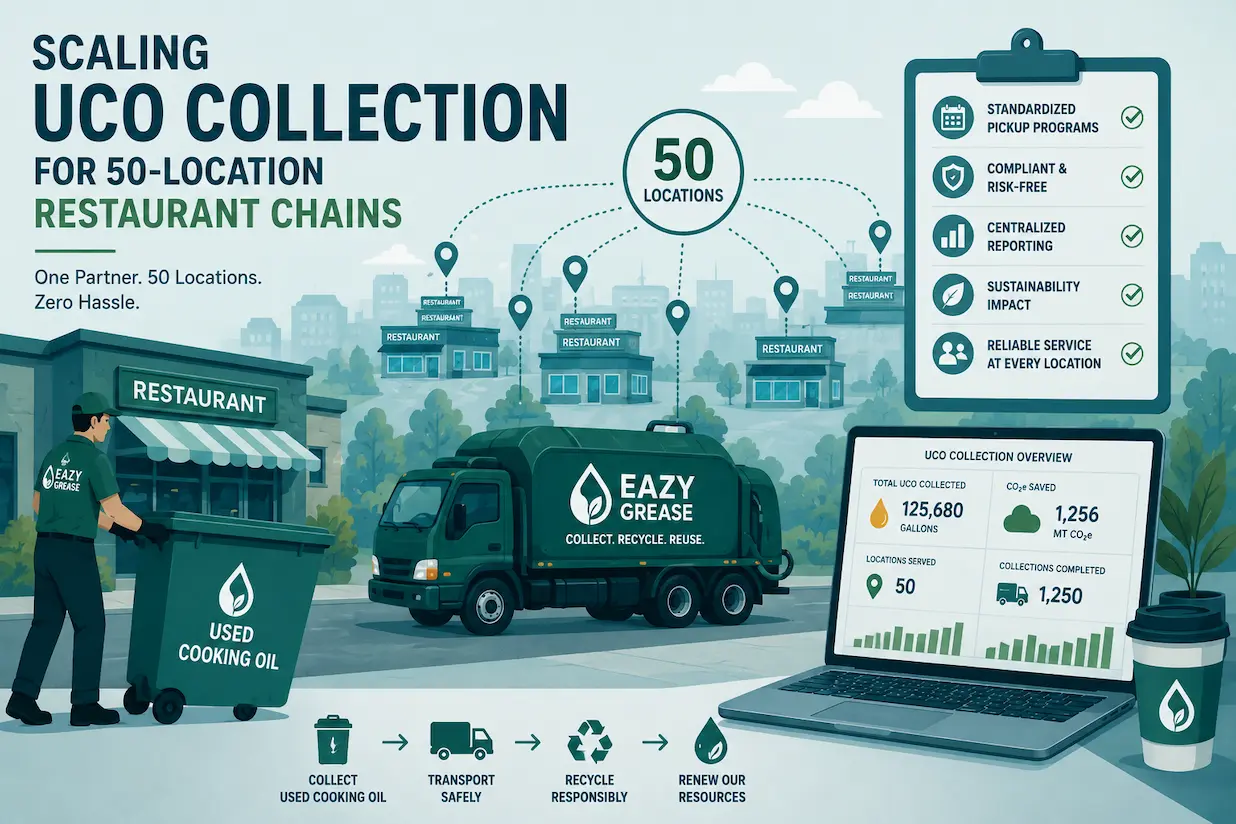
Scaling UCO collection for 50-location restaurant chains is one of the most underestimated operational challenges in the foodservice industry. When a chain grows from a handful of locations to dozens spread across multiple markets, the informal systems that worked at small scale start generating real costs: missed pickups, inconsistent rebates, compliance gaps, and labor inefficiencies that multiply across every location in the portfolio.
The global used cooking oil market was valued at approximately $8 billion in 2024 and is projected to reach nearly $12 billion by 2030, growing at a compound annual growth rate of around 7%. The foodservice segment, which includes restaurant chains, convenience stores, and hospitals, holds the largest share of that market. For multi-unit operators, that means the oil coming out of your fryers is part of a valuable, growing commodity supply chain. Managing it well is not just an environmental obligation. It is a material business decision.
This post is the operational playbook for restaurant chains expanding to 50 locations and beyond. It covers standardization, supply chain management, technology, sustainability, and the financial case for treating used cooking oil as a strategic asset rather than a waste disposal problem.
Why UCO Collection Breaks Down at Scale
Independent restaurants and small chains can manage used cooking oil with relatively informal systems. A single provider, a phone call when the container is full, and a monthly rebate check is often enough. But as restaurant chains grow to 10, 20, and then 50 or more locations, the cracks in that approach begin to show.
The core problems that emerge at scale include:
Inconsistent procedures across locations. When each restaurant in a chain handles used cooking oil differently, the result is inconsistent oil quality, variable rebate rates, and uneven compliance records. Inconsistent procedures lead to waste and inefficiencies that compound across every location.
No visibility into aggregate volume. Without centralized data, corporate operations teams cannot see how much used cooking oil the chain is generating in total, which markets are underperforming on rebates, or which locations are approaching overflow between scheduled pickups.
Fragmented provider relationships. Many expanding restaurant chains end up with different UCO providers across different markets, making it impossible to negotiate volume-based rebate rates or enforce consistent service standards.
Labor inefficiencies. Manual oil handling at each location creates ongoing labor costs, burn and slip risks, and staff time that could be better spent on customer experience. At scale, these inefficiencies become significant.
Supply chain blind spots. Without standardized supply chain management across UCO collection, restaurant chains cannot accurately forecast disposal costs, rebate income, or the environmental impact of their operations.
The 60/40 Rule and the 30/30/30/10 Rule: What They Mean for Restaurant Operations
Two common frameworks circulate in restaurant operations discussions, and both have implications for how chains should think about UCO collection at scale.
The 60/40 restaurant rule refers to the common industry guideline that food costs and labor costs together should not exceed 60% to 65% of revenue, with the remaining margin covering overhead, occupancy, and profit. Used cooking oil management touches both sides of this equation. Oil is a food cost input, and labor for manual oil handling is a labor cost. Reducing labor for oil handling through automation and improving rebate income both improve margin performance within the 60/40 framework.
The 30/30/30/10 rule is a guideline used in some foodservice operations contexts to allocate revenue across food costs, labor, overhead, and profit. The specific percentages vary by chain type and service model. For quick service restaurant chains, where margins are tighter and operational efficiency is a key competitive lever, every inefficiency in back-of-house processes, including oil management, has an outsized impact on the 10% profit target.
For full service restaurant chains, where cooking oil volume per location tends to be higher and fryer usage more varied across a broader menu, standardizing UCO collection becomes even more complex but also more financially significant.
How Big Is the Used Cooking Oil Market?
The used cooking oil market is large and growing rapidly. The global used cooking oil market size was estimated at approximately $8 billion in 2024 and is projected to reach nearly $12 billion by 2030, growing at a CAGR of around 7%. North America dominated the global used cooking oil industry with a revenue share of 41.7% in 2024, and the U.S. held the largest share of the regional industry.
The biodiesel production segment dominated the used cooking oil market with a revenue share of 50% in 2024. Demand is now expanding into renewable diesel and sustainable aviation fuel as airlines and transportation companies seek low-carbon feedstocks to meet decarbonization goals.
For restaurant chains, this market growth is relevant in two ways. First, rising demand for UCO as a feedstock supports higher rebate rates for high-volume operators. Second, the expanding market is attracting more sophisticated collection companies with better technology, more reliable service, and more competitive pricing, giving chains more leverage to demand quality from their providers.
In 2024 alone, 363.7 million pounds of used cooking oil were recycled in the U.S., preventing over 80 million pounds of CO2 equivalent emissions. Restaurant chains that participate in this supply chain through structured, standardized UCO programs are contributing meaningfully to national decarbonization goals while also earning financial return on what would otherwise be a waste disposal cost.
The Fastest Growing Restaurant Chains and the UCO Challenge
What is the fastest growing restaurant chain in the U.S.? By unit count growth, Raising Cane’s Chicken Fingers opened 118 new restaurants in 2024, topping 850 locations by early 2025, a 20% jump in one year. Jersey Mike’s Subs, following its acquisition by Blackstone, plans to open 1,000 new U.S. stores from 2025 to 2027.
Chains growing at this pace face an acute version of the UCO scaling problem. Every new location that opens adds fryer capacity, oil volume, and collection complexity to the portfolio. Without a standardized UCO program established before the expansion accelerates, chains find themselves managing a patchwork of local providers, inconsistent container setups, and highly variable rebate structures across markets.
Shake Shack planned to open around 80 new stores in 2024, expanding its footprint by about 15%. Shake Shack is also one of the restaurant chains that works with Restaurant Technologies, the Mendota Heights, Minnesota-based privately held company that delivered almost 720 million pounds of fresh cooking oil and recycled over 393 million pounds of used cooking oil in 2025. When expanding chains establish UCO partnerships early, they build a program that scales with them rather than having to retrofit a solution once the portfolio is already large.
Standardizing UCO Operations Across Multiple Locations
Standardization is the foundation of effective UCO management at scale. Multi-unit operators that standardize their UCO collection programs can reduce costs by 10% to 35% compared to managing the function informally across locations.
Standardization means the same container types and sizes at every location, the same staff procedures for draining fryers and transferring oil, the same compliance documentation at every pickup, and the same provider relationship across all markets where possible. When procedures vary by location, quality varies, rebates vary, and compliance risk increases.
Standard Operating Procedures for UCO Handling
Every restaurant in the chain should follow the same documented process:
Oil is cooled to a safe handling temperature before transfer. Staff transfer cooled oil into designated containers using proper equipment. Containers are sealed and secured after each transfer. Fill levels are checked daily and reported through the chain’s operational system. Pickups are scheduled based on actual volume output at each location, not on a fixed calendar.
Standardized best practices help restaurant chains scale efficiently because every new location that opens can onboard the same UCO program from day one rather than developing its own approach.
Visual Bin Observations
In addition to digital monitoring, many chains implement visual bin observation protocols. Staff perform a quick check of container fill level, lid seal, and surrounding area cleanliness at each shift. This catches problems, including overflow risk, theft, and container damage, before they escalate and before the next scheduled pickup.
Technology: From Manual Handling to Automated UCO Systems
Technology is transforming UCO collection for restaurant chains, and the gap between chains using automated systems and those still relying on manual handling is widening rapidly.
Smart Tank Monitoring
Smart sensors on UCO tanks monitor fill levels in real-time, transmitting data to both the restaurant’s operations team and the collection provider. When a tank approaches capacity, an automated alert triggers a pickup rather than waiting for a fixed schedule. This prevents overflow, reduces emergency pickup costs, and ensures oil quality is maintained by preventing tanks from sitting at capacity too long.
At Eazy Grease, our smart tank monitoring option gives restaurant chains the same real-time visibility, with sensors that track fill levels continuously and notify our team the moment a pickup is needed, so your locations never wait on a fixed schedule that does not match actual volume.
Closed-Loop Automated Systems
For high-volume restaurant chains, closed-loop automated oil management systems represent the most significant efficiency opportunity. Automated collection systems eliminate manual handling of used cooking oil entirely. Fresh cooking oil is delivered into an indoor storage tank, flows to fryers as needed, and used oil is automatically transferred to a separate collection tank. Service vehicles connect to the outdoor fill point to deliver fresh cooking oil and collect used oil in a single visit.
These automated closed-loop systems significantly increase worker safety in UCO management by eliminating manual oil transfer. They also reduce labor costs substantially. Automated systems reduce safety risks for staff handling hot oil, which is one of the most common sources of kitchen burns.
Automated Price Verification
One underutilized technology application at chain scale is automated price verification for UCO transactions. Rebate rates fluctuate with commodity markets, and without automated verification, chains can be overbilled or underpaid without detection. Automated price verification prevents thousands in overcharges per location, and across a 50-location chain, that number compounds significantly. Tightening supply chain processes through automated verification saves thousands annually for multi-unit operators.
Supply Chain Management for UCO at Chain Scale
Effective supply chain management for used cooking oil collection at chain scale requires thinking about UCO not as a single-location waste problem but as a consolidated commodity stream that generates value proportional to how well it is managed.
Centralized Program Management
Centralized program management balances profitability and sustainability in UCO management. Rather than each location manager negotiating independently with local providers, a centralized UCO program establishes a master service agreement with one or a small number of providers, standardizes container specifications, sets rebate terms at the aggregate volume level, and tracks performance centrally.
This approach gives the chain visibility into total UCO volume across all locations, the ability to identify underperforming markets, and the leverage to negotiate based on aggregate volume rather than individual location output.
Volume Consolidation and Rebate Negotiation
Rebate rates for used cooking oil are volume-dependent. A single quick service restaurant generating 50 gallons per week negotiates from a very different position than a 50-location chain generating 2,500 gallons per week from that same menu. Consolidating UCO volume across all locations into a single provider relationship is often the single highest-return action a growing chain can take on its UCO program.
Using bulk oil delivery approaches has helped chains keep 30 million pounds of waste out of landfills while simultaneously improving operational efficiency and rebate income.
Cross-Location Scheduling Optimization
Efficient supply chain management also means optimizing pickup schedules across multiple locations in a market. When a provider serves multiple locations for the same chain in the same city, route efficiency improves, pickup costs decrease, and service reliability increases. Chains that coordinate scheduling across nearby locations can often negotiate better terms than chains that treat each location’s scheduling independently.
Sustainability: The Environmental Impact of Scaled UCO Recycling
Restaurant chains that scale their UCO collection programs do not just improve margins. They make a measurable environmental impact.
Recycling used cooking oil prevented over 80 million pounds of CO2 equivalent emissions in 2024. When used cooking oil is converted into renewable diesel or biodiesel, it displaces fossil fuel consumption on a lifecycle basis. When it is converted into sustainable aviation fuel, it helps airlines reduce the carbon intensity of air travel, one of the hardest sectors to decarbonize.
The environmental benefits of scaled UCO recycling extend across several dimensions:
Landfill space. Used cooking oil sent to landfills takes up landfill space and degrades into methane, a potent greenhouse gas. Recycling used cooking oil conserves landfill space while simultaneously reducing packaging waste associated with oil drums and containers that would otherwise be disposed of.
Water resources. Used cooking oil that enters waterways, whether through improper disposal or spills that reach storm drains, causes serious harm to aquatic ecosystems. One gallon of used cooking oil can make one million gallons of fresh water undrinkable. At chain scale, the aggregate environmental benefit of keeping that oil in a compliant recycling stream is significant.
Carbon emissions. Converting used cooking oil into renewable diesel or biodiesel produces substantially lower lifecycle greenhouse gas emissions compared to petroleum diesel. Some processes achieve up to 80% emissions reduction on a lifecycle basis.
For restaurant chains that report on environmental impact to investors, franchisors, or customers, a well-documented UCO recycling program provides verifiable, quantifiable sustainability data. Reducing waste is a stated priority for most major chain operators, and UCO recycling is one of the most straightforward ways to demonstrate progress.
The Financial Case: Revenue, Rebates, and Cost Reduction
The financial case for a standardized, scaled UCO program is compelling across multiple line items.
Rebate income. Multi-unit operators that consolidate UCO collection earn rebates based on aggregate volume. Across a 50-location quick service chain generating an average of 60 gallons per location per week, total weekly volume is approximately 3,000 gallons. At a rebate rate of $0.50 to $1.00 per gallon, that is $1,500 to $3,000 in weekly rebate income, or $78,000 to $156,000 annually, from oil that would otherwise cost money to dispose of.
Labor cost reduction. Automated systems reduce labor time for oil handling. Across 50 locations, even a modest reduction in weekly staff time spent on oil management produces meaningful annual labor savings.
Compliance cost avoidance. Failure to comply with environmental laws regarding fats, oils, and grease can lead to fines that vary widely by jurisdiction. At chain scale, a consistent compliance program across all locations eliminates the risk of isolated violations that generate fines, failed inspections, and negative public records.
Menu efficiency. Extended oil life through proper management and filtration reduces fresh cooking oil purchase frequency. Using bulk oil delivery and standardized oil management can reduce cooking oil costs significantly across a chain portfolio. This directly improves menu item profitability without requiring any menu engineering changes.
First Watch, one of the fastest-growing full service restaurant chains in the country, planned to open 51 to 57 new restaurants in 2024. For chains growing at this rate, establishing UCO program standards before expansion accelerates ensures that every new location is generating rebate income and operating compliantly from day one rather than retrofitting compliance onto an inconsistent back-of-house operation.
Building a UCO Program for a 50-Location Chain: Step by Step
Here is a practical framework for building or upgrading a UCO program at chain scale.
Step 1: Audit Current UCO Operations
Start with a full audit of how each location currently handles used cooking oil. Document container types, provider relationships, pickup frequency, rebate rates, and any compliance issues at each location. This baseline reveals the true cost of the current approach and identifies the highest-priority markets for standardization.
Step 2: Consolidate Provider Relationships
Identify one or two providers with geographic coverage across your market footprint and the capability to support your total volume. Issue a request for proposal that includes your aggregate volume, required service standards, documentation requirements, and rebate expectations. Negotiate on the basis of total chain volume rather than individual location volume.
Step 3: Standardize Equipment Across Locations
Work with your selected provider to standardize container types and sizes across the portfolio. High-volume locations should receive automated systems that connect directly to fryers. Medium-volume locations should receive appropriately sized outdoor tanks with smart monitoring. Smaller or lower-volume locations should receive indoor eco-tubs or 55-gallon drums sized to their actual output.
Step 4: Implement Digital Documentation
Digital documentation for pickups provides accountability and service history tracking at every location. Every pickup should generate a digital record that is automatically stored in your central compliance system. This creates an auditable service history that supports health inspections and any environmental compliance reviews.
Step 5: Train Teams and Monitor Performance
Roll out standardized training to kitchen teams at every location. Then monitor performance using the data from smart tank sensors and digital pickup records. Track rebate income by location, identify outliers, and use the data to continuously optimize scheduling and container sizing.
Step 6: Report and Improve
Build UCO recycling metrics into your regular sustainability reporting. Tracking pounds of used cooking oil recycled, rebate income generated, and emissions reductions achieved by location and in total gives your operations team and your stakeholders a clear picture of the program’s value. Use this data to drive continuous improvement and to negotiate better terms as your volume grows.
What to Demand from Your UCO Provider at Chain Scale
Not every UCO collection company has the infrastructure to serve a 50-location chain consistently. Here is what chain operators should demand from a provider before signing any agreement:
Geographic coverage. The provider must be able to service every location in your current footprint and have the infrastructure to expand service to new markets as you grow. Gaps in coverage force you back to fragmented local relationships.
Smart monitoring technology. Providers serving multi-unit operators should offer smart tank sensors that transmit fill-level data in real-time. Manual monitoring at chain scale is too labor-intensive and too prone to missed pickups.
Guaranteed response times. Service agreements for multi-unit operators should include guaranteed response times for emergency pickups and escalation procedures for service failures. A single missed pickup at a high-volume location creates real operational and compliance risk.
Digital documentation at every pickup. Every collection visit should generate a digital record that is automatically shared with your central compliance team. Paper manifests that have to be manually entered into a system create data gaps and audit risk.
Volume-based rebate transparency. Your provider should share market price data regularly and explain exactly how rebates are calculated at each pickup. Automated price verification prevents overcharges and ensures your rebate income accurately reflects current commodity market conditions.
Customer support. Excellent customer support ensures prompt communication and responsiveness when issues arise. At chain scale, a provider that is hard to reach when problems occur creates compounding operational risk across multiple locations simultaneously.
Eazy Grease and Multi-Location Restaurant Programs
At Eazy Grease, we work with restaurant chains at multiple stages of their scaling journey, from emerging brands expanding to new markets to established multi-unit operators looking to consolidate and standardize their UCO programs.
We provide centralized program management, standardized equipment across all locations, smart monitoring options for high-volume sites, consistent digital documentation for compliance, and rebate structures that reflect aggregate chain volume rather than individual location pricing. Our coverage spans the East Coast including Florida, Georgia, Alabama, Tennessee, South Carolina, North Carolina, Pennsylvania, Connecticut, New Jersey, and New York, making us a strong partner for restaurant chains expanding across the Southeast and Northeast.
If your chain is growing and your UCO program has not kept pace, the cost of that gap is already showing up in your operations, even if it is not yet visible on a line item. Let us show you what a properly scaled program looks like for your portfolio.
Ready to Scale Your UCO Program?
Get a Free Chain Assessment at Eazygrease.com – share your location count, approximate oil volume per location, and current provider situation. We will respond within one business day with a program proposal and rebate estimate for your full portfolio.