
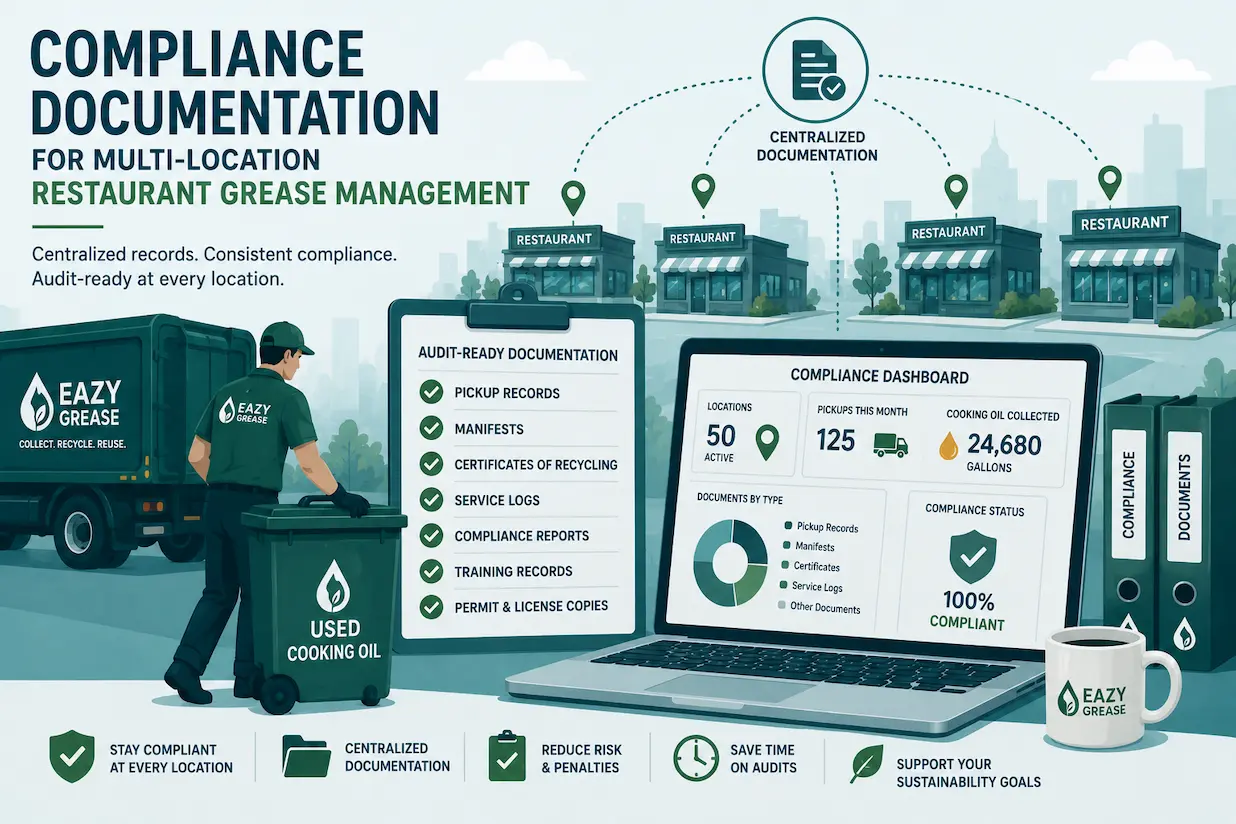
Multi-location restaurant operators face one of the most complex grease management compliance landscapes in the food service industry. Each city has its own FOG regulations, each municipality sets its own wastewater discharge requirements, and health inspectors across different jurisdictions may expect different documentation formats at every inspection. Getting this wrong at one location creates risk across an entire portfolio.
This post covers what the FOG regulations actually require, how grease interceptors work, how plumbing systems are affected by poor grease management, and how used cooking oil collection fits into a complete FOG compliance program.
What Is FOG and Why Does It Drive Compliance Requirements
FOG stands for fats, oils, and grease. Every commercial kitchen produces FOG as a byproduct of cooking. Sauces, deep frying, dishes washed with food residue, and the rendering of meat all contribute FOG to the wastewater that flows into municipal sewer systems. The EPA mandates municipalities to reduce sanitary sewer overflows, which places the responsibility for managing grease directly on restaurant establishments.
Municipalities require commercial kitchens to hold active wastewater discharge permits, and compliance documentation for fats, oils, and grease management is an essential condition of maintaining those permits. For multi-location restaurants, this means maintaining a separate compliance file for every location, often with different requirements depending on the city.
Grease Traps vs. Grease Interceptors: What Multi-Location Operators Need to Know
Understanding the difference between grease traps and grease interceptors is the starting point for any FOG compliance program.
Grease Traps
These compact units are typically installed under sinks in small kitchens or lower-volume establishments. They intercept fats and oils before wastewater enters the sewer line, allowing grease to float and separate from water flow. Grease traps are often the required installation for coffee shops, small cafes, and lower-volume operations where the volume produced does not justify a larger external interceptor.
These units must be cleaned every 30 to 90 days depending on kitchen volume and local regulations. They should never be more than 25% full of accumulated grease and solids to function properly. When the unit exceeds that threshold, water flow through the plumbing systems is restricted, oils and fats pass through into the sewer line, and the risk of blockages and health code violations increases significantly.
Grease Interceptors
Grease interceptors are larger systems designed for higher-volume commercial kitchens. They can be located inside or outside the facility depending on available space and local code requirements. There are two primary types:
Hydromechanical grease interceptors are rated from 10 GPM to 100 GPM and are typically installed indoors. They rely on baffles and flow control to separate grease from wastewater under pressure, making them suitable for moderate-volume kitchens where an outdoor installation is not practical.
Gravity grease interceptors are the standard for high-volume commercial kitchens. They typically range from 750 to 2,000 gallons in capacity and are installed underground outside the facility. Gravity allows FOG buildup to separate and rise to the surface in the tank while clarified water exits through the outlet. Like smaller trap units, grease interceptors must not exceed 25% capacity to function properly and must be cleaned regularly to meet code requirements.
Most municipalities require grease interceptors for commercial kitchens above a certain volume threshold. Failure to install the correct type for your kitchen volume, or failure to maintain it on the required schedule, can lead to fines, health code violations, and in serious cases, sewer service disconnection.
What Is Florida Statute 403.0741?
Florida Statute 403.0741 is one example of how individual states codify used cooking oil disposal requirements for restaurant establishments. The statute regulates how cooking oil must be stored, transported, and disposed of or recycled, establishing that used cooking oil cannot go into regular trash or sewers and must be collected by a licensed hauler.
Similar statutes and local ordinances exist across the East Coast. Connecticut mandates recycling of used cooking oil for restaurants. New York City enforces strict grease disposal codes through the Department of Environmental Protection. New Jersey, Georgia, and other states each maintain their own FOG management frameworks that restaurants must comply with at the local level.
For multi-location operators, the practical implication is that compliance documentation requirements may differ from state to state and city to city. A centralized compliance program needs to account for those differences rather than applying a single standard across all locations. Collection service manifests, hauler licensing verification, and storage documentation should be maintained at every location regardless of which state it operates in.
State and Local Grease Management Requirements Across the East Coast
FOG regulations vary significantly by jurisdiction. What is required in New York City may differ from what Atlanta, Charlotte, or Nashville enforces. What Miami-Dade mandates may not match the requirements in Savannah or Allentown. Multi-location operators cannot assume that compliance at one location means compliance everywhere.
The common thread across most East Coast jurisdictions is this: commercial kitchens must install properly sized grease interceptors, maintain them on a documented schedule, use licensed haulers for pump-outs and UCO collection, and retain service manifests on-site for inspector review.
For new restaurant openings, interceptor installation is typically a condition of receiving a certificate of occupancy in most cities. For existing establishments, service manifests must be generated at every cleaning visit and retained for a minimum of two to three years depending on the local requirement. Businesses that cause grease discharge damage to municipal sewer systems can be held financially responsible for remediation costs on top of any fines issued for non-compliance.
Does a Coffee Shop Need a Grease Trap?
In most jurisdictions, yes. Even lower-volume establishments like coffee shops produce FOG through milk steamers, food preparation sinks, and dish washing. Most municipalities require grease interceptors for commercial kitchens regardless of size, though the type and capacity of the required unit will differ from what a full-service restaurant installs.
A small coffee shop may only require a compact hydromechanical unit or an under-sink trap, while a full-service restaurant with multiple fryers will typically require a large gravity interceptor installed outdoors. Any establishment producing FOG wastewater above a de minimis threshold is subject to FOG management regulations and must maintain documentation of cleaning and maintenance to stay compliant.
Coffee shop operators who assume their lower volume exempts them from FOG requirements are at risk of failed inspections and fines. Checking local municipal requirements at the time of permitting is the correct approach, and maintaining service records from the point of opening protects the business in the event of an audit.
How Multi-Location Operators Should Structure Their Compliance Documentation
Compliance documentation for multi-location restaurant grease management needs to be consistent across facilities even when local requirements differ. A centralized compliance program is required for effective grease management at scale.
For each location, maintain a dedicated compliance file that includes:
The wastewater discharge permit and any amendments issued by the local municipality. This permit establishes the legal baseline for FOG management at that location and must be renewed on the schedule the municipality requires.
Service records for interceptor cleaning. These records should include the date of service, the name and license number of the hauler, the volume of FOG removed, and any notes on the condition of the unit. Service manifests are required for every cleaning job and should be retained for at least three years in most jurisdictions.
Used cooking oil collection manifests. Every used cooking oil pickup should generate a manifest or digital service log confirming the volume collected, the date, and the licensed hauler who performed the service. Under Florida 403.0741 and similar statutes in other states, these records are essential for demonstrating compliance during inspections.
Inspection history and any notices of violation. Keeping a record of past inspections, including the outcome and any corrective actions taken, demonstrates to health inspectors and regulators that the business takes FOG compliance seriously and responds promptly to issues.
Equipment maintenance records. Interceptors and trap units are mechanical systems that require regular inspection in addition to cleaning. Documenting equipment condition, any repairs made, and any parts replaced supports a complete maintenance history for each location.
How Restaurant Should Dispose of Grease
Used oil and grease waste from commercial kitchens must be handled through licensed, compliant channels. The correct approach has two components.
The liquid used cooking oil that drains from fryers must be stored in sealed containers and collected by a licensed recycling service. Oil collected through professional services is converted into biodiesel and other renewable products, which is both the environmentally responsible outcome and the legally required one in most jurisdictions. Oils that go down drains or into regular trash violate environmental regulations and plumbing codes and can lead to health code violations, fines, and sewer damage.
The FOG buildup in grease interceptors is a different material, typically a semi-solid mixture of fats, oils, water, and food solids that has separated over time. This material must be pumped and removed by a licensed hauler on a schedule determined by kitchen volume and local code. It cannot be disposed of on-site and requires specialized transport through authorized facilities.
Staying compliant with both sides of this equation requires working with licensed service providers for each. Grease trap services and used cooking oil collection are distinct services with distinct regulatory requirements, different equipment, and different disposal pathways.
FOG Compliance and Used Cooking Oil Collection: How They Work Together
For multi-location restaurant operators, FOG compliance is most effectively managed when both grease interceptor maintenance and used cooking oil collection are treated as documented, scheduled operations rather than reactive ones.
Staying compliant on the used cooking oil side means partnering with a licensed collection company that provides digital service logs at every pickup, schedules collection based on your actual fryer output, and maintains the documentation your compliance file requires. Eazy Grease provides exactly this for commercial kitchens across our East Coast service area, including Florida, Georgia, Alabama, Tennessee, South Carolina, North Carolina, Pennsylvania, Connecticut, New Jersey, and New York.
Our used cooking oil collection service generates a service record at every pickup, confirming the volume collected, the date, and the destination for recycling. These records are formatted to support compliance requirements across the states we serve and can be integrated into a multi-location compliance program managed centrally.
Staying compliant on the grease trap and grease interceptor side requires a separate licensed provider who performs pump-outs on the required schedule and issues manifests that meet local code requirements. For multi-location operators, choosing providers on both sides who deliver consistent documentation across all locations simplifies audit preparation and reduces compliance risk across the portfolio.
A Compliance Checklist for Multi-Location Grease Management
The following checklist applies to each location in a multi-restaurant portfolio:
Active wastewater discharge permit on file and current. Grease interceptors correctly sized and installed for kitchen volume. FOG units cleaned every 30 to 90 days by a licensed hauler. Service manifests retained for every cleaning visit. Used cooking oil stored in sealed containers and collected by a licensed recycling service. UCO collection manifests retained for every pickup. Inspection history documented with corrective actions on record. Equipment maintenance records current and accessible.
Running this checklist quarterly at each location and reviewing the results centrally gives multi-location operators a real-time picture of compliance status across the portfolio and identifies gaps before they become violations.
Ready to Get Your UCO Collection Documentation in Order?
At Eazy Grease, we provide licensed used cooking oil collection with digital service documentation at every pickup, formatted to support FOG compliance requirements across Florida, Georgia, and the full East Coast. No contracts, no hidden fees, and a service record your compliance team can rely on.
Request a Free Quote at Eazygrease.com — tell us your location count and fryer volume and we will set up a collection program with the documentation your multi-location compliance program requires.
Eazygrease.com | Used Cooking Oil Collection and Compliance Documentation | FL, GA, AL, TN, SC, NC, PA, CT, NJ, NY