
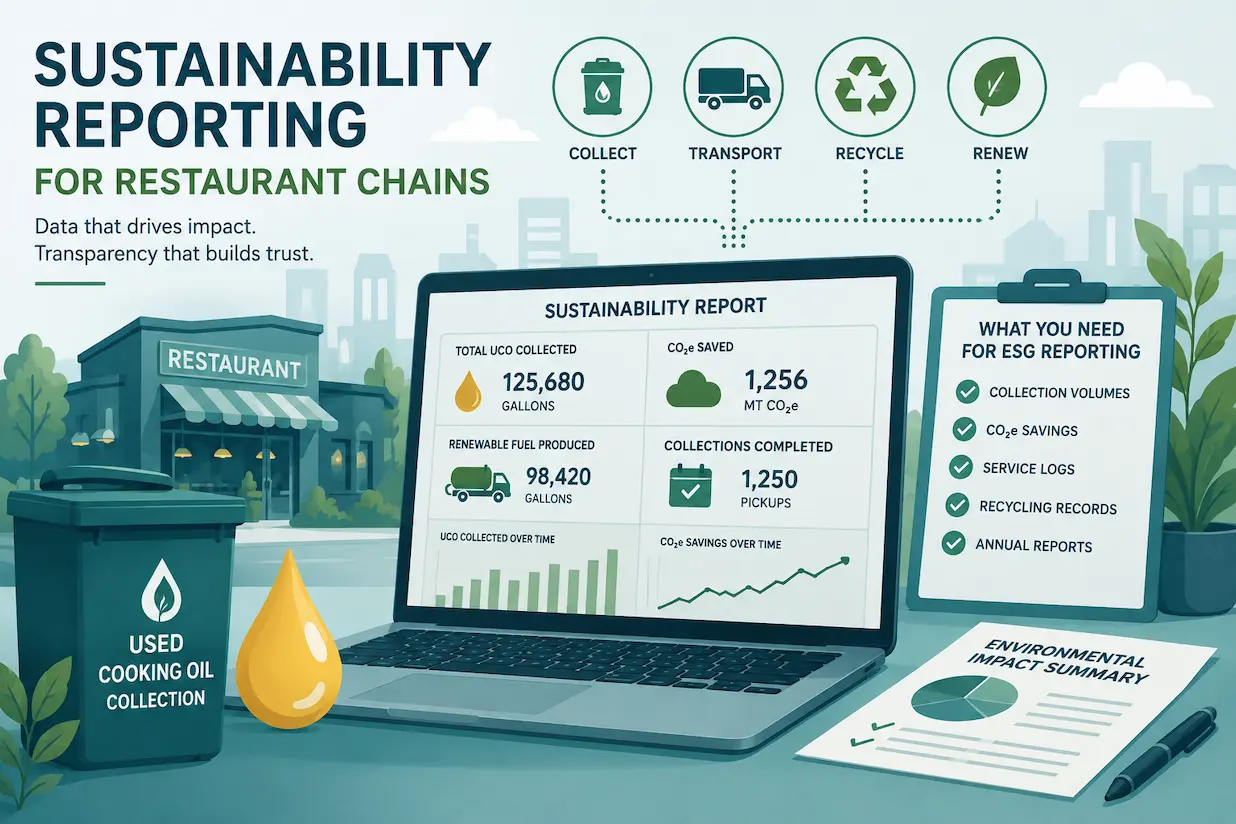
Sustainability reporting for restaurant chains is no longer a voluntary exercise reserved for the largest publicly traded brands. ESG reporting expectations from investors, franchisors, regulators, and customers are expanding across the full service restaurant chains segment, and the data points that matter most include energy consumption, carbon emissions, waste diversion, packaging waste reduction, and supply chain impacts. For restaurant chains serious about their sustainability goals, used cooking oil management sits directly at the intersection of all of these.
This post covers what restaurant chains need to understand about sustainability reporting frameworks, what your UCO partner should be providing to support your reporting process, and how leading companies are turning used cooking oil recycling into one of their most measurable and defensible environmental impact stories.
What Are the Frameworks of Sustainability Reporting?
Restaurant chains approaching ESG reporting for the first time typically encounter several competing frameworks. Understanding the differences helps sustainability teams choose the right structure for their reporting process.
The Global Reporting Initiative (GRI) is the most widely used sustainability reporting framework in the world. As of 2022, 78% of the world’s 250 largest companies by revenue used GRI standards in their sustainability disclosures. GRI standards are modular, covering Universal Standards that apply to all organizations and Topic Standards that cover specific material ESG topics including energy efficiency, greenhouse gas emissions, waste, and supply chain. For restaurant chains, GRI provides the most comprehensive and widely recognized structure for disclosing environmental and social impacts.
The Sustainability Accounting Standards Board (SASB) provides industry-specific metrics, including a dedicated standard for the restaurant industry. SASB focuses on the ESG factors most likely to be material to financial performance, making it particularly relevant for chains with institutional investors or public reporting obligations.
The Task Force on Climate-related Financial Disclosures (TCFD) focuses specifically on climate-related risks and opportunities. Regulatory bodies in the U.S., UK, and EU are increasingly referencing TCFD as a baseline for mandatory reporting requirements. Chains that disclose climate-related risks through TCFD align themselves with the direction of mandatory reporting globally.
The Food Loss and Waste Accounting and Reporting Standard (FLW Standard) is a more specialized framework that provides guidance on measuring and reporting food waste across the supply chain. For full service restaurant chains with significant waste streams, including used cooking oil and packaging waste, the FLW Standard provides granular reporting guidance.
Most restaurant chains combine elements of multiple frameworks rather than selecting one exclusively. GRI provides the overall structure, SASB provides the industry-specific metrics, and TCFD provides the climate risk overlay. Used cooking oil recycling data feeds directly into GRI waste disclosures, SASB waste diversion metrics, and TCFD carbon reduction reporting simultaneously.
What Are the 7 Principles of Sustainability Reporting?
The GRI framework is grounded in reporting principles divided into two groups: principles that define report content and principles that define report quality.
The four content principles are stakeholder inclusiveness, materiality, sustainability context, and completeness. Stakeholder inclusiveness requires chains to identify and engage stakeholders when determining what to report. Materiality requires focusing on the issues that most significantly affect environmental and social impacts. Sustainability context places individual chain performance within the broader global sustainability picture. Completeness requires that material topics are covered sufficiently for stakeholders to assess the chain’s performance.
The quality principles are accuracy, balance, clarity, comparability, reliability, and timeliness. These define how information should be presented: factually accurate, balanced rather than purely positive, clear to a diverse audience, comparable across reporting periods, based on reliable data sources, and published on a schedule that keeps information current.
For used cooking oil data specifically, these principles mean that chains should report actual gallons collected rather than estimates, compare performance year over year, include the downstream impact of recycling in terms of CO2e avoided, and present the data in a format that external auditors or regulators can verify.
What Are the 5 C’s of Sustainability?
The 5 C’s of sustainability, as commonly referenced in corporate sustainability strategy, are: Commitment, Consistency, Credibility, Communication, and Collaboration.
Commitment means setting measurable sustainability goals and backing them with resources. Consistency means applying the same standards across all locations and reporting periods. Credibility means using third-party verified data and recognized frameworks rather than self-reported estimates. Communication means publishing sustainability accomplishments clearly and accessibly for all stakeholders. Collaboration means working with supply chain partners, including your UCO collection partner, to define sustainability and achieve goals that no single party could reach alone.
All five of these principles apply directly to how restaurant chains manage and report their used cooking oil program. A UCO partner that does not provide verifiable collection data, CO2e calculations, and documented recycling outcomes is a liability to any chain’s sustainability strategy, not an asset.
What Are Some Sustainable Practices for Restaurants?
Restaurant chains looking to define sustainability practices for their operations and for their ESG reporting should focus on the areas with the most measurable impact.
Used cooking oil recycling. Converting used cooking oil into renewable diesel, biodiesel, or sustainable aviation fuel is one of the most quantifiable sustainability actions a restaurant chain can take. The resulting renewable diesel that replaces traditional petroleum-based fuels can cut tailpipe emissions by up to 75%. Every gallon collected and recycled instead of discarded represents a verifiable unit of waste diversion and carbon reduction that feeds directly into ESG data.
Eliminating packaging waste. Bulk oil delivery systems eliminate the need for individual oil jugs, reducing packaging waste significantly. Restaurant Technologies, the leading provider of automated commercial kitchen solutions based in Mendota Heights, Minnesota, reported that in 2024 the company and its partners helped save about 29.6 million pounds of trash and 8.9 million cubic feet of landfill space through eliminated plastic packaging alone. For restaurant chains working to reduce packaging waste across their supply chain, switching from jug-based fresh oil delivery to automated bulk delivery is one of the highest-impact single changes available.
Reducing manual cooking oil handling. Automated systems that deliver fresh cooking oil and collect used cooking oil without manual handling by kitchen staff reduce labor practices risk, eliminate burn and spill incidents, and improve operational efficiency. These systems also ensure that oil is transferred correctly every time, protecting oil quality and the resulting environmental impact of the recycled output.
Energy efficiency in the kitchen. Smart fryer management, including monitoring oil temperature and extending oil life through proper filtration, reduces both fresh cooking oil consumption and the frequency of oil changes, lowering the total volume of used cooking oil needing collection while also reducing energy consumption from overheated or poorly maintained fryers.
Supply chain transparency. For grocery and convenience stores with food service operations, as well as full service restaurant chains, supply chain transparency means being able to document where inputs come from, how waste outputs are handled, and what environmental outcomes result from each supply chain relationship.
What Your UCO Partner Should Provide for ESG Reporting
The gap between restaurant chains that can include UCO recycling data in their ESG reporting and those that cannot almost always comes down to what their UCO partner provides. Here is what to demand.
Gallons collected by location and period. Your partner should provide accurate, verifiable collection data by location and by reporting period. This data feeds directly into your waste diversion metrics and is the foundation for all downstream calculations.
CO2e avoided calculations. Recycling cooking oil into renewable diesel or renewable fuels reduces greenhouse gas emissions relative to petroleum alternatives. Your UCO partner should provide or support the calculation of CO2e avoided based on the volume collected and the destination use of the recycled oil. This number is directly reportable under GRI waste disclosures and SASB restaurant sector metrics.
Renewable energy partner documentation. The credibility of your sustainability accomplishments depends partly on who processes the oil after collection. Eazy Grease and Restaurant Technologies, for example, partners with renewable energy partners such as Chevron Renewable Energy Group and Phillips 66 to convert used cooking oil into renewable diesel or biodiesel. In 2025, Restaurant Technologies delivered almost 720 million pounds of fresh cooking oil and recycled over 393 million pounds of used cooking oil, with support from renewable energy partners such as Phillips 66, converting nearly 100% of its UCO into renewable diesel or biodiesel or sustainable aviation fuel. Your partner should be able to document where your oil goes and what it becomes.
Packaging waste avoided. If your UCO partner delivers fresh cooking oil in bulk rather than individual jugs, the packaging waste eliminated is a reportable sustainability metric. Document the number of jugs eliminated and the associated weight of packaging waste avoided.
Annual impact summary. At minimum, your UCO partner should provide an annual summary of total volume collected, CO2e avoided, landfill space conserved, and renewable fuel produced from your account. This document should be formatted to support your sustainability reporting and available in time for your annual reporting cycle.
Digital service logs for every pickup. For chains subject to regulatory compliance or external ESG audits, every collection visit should generate a digital record. These logs create the audit trail that transforms self-reported sustainability claims into verifiable ESG data.
How Eazy Grease Sets the Standard for East Coast Restaurant Chains
Eazy Grease is the trusted used cooking oil partner for restaurant chains across the East Coast, providing collection services throughout Florida, Georgia, Alabama, Tennessee, South Carolina, North Carolina, Pennsylvania, Connecticut, New Jersey, and New York. Every pickup is backed by digital service documentation, giving chains a verifiable audit trail for every collection visit rather than self-reported estimates.
Every gallon of used cooking oil Eazy Grease collects is processed into biodiesel and other renewable products, delivering measurable environmental impact that restaurant chains can point to directly in their own sustainability reporting. Combined with monthly reporting on volume collected, this gives chains across the East Coast a documented, closed-loop story: oil is collected, converted, and put back to work as a renewable fuel.
What sets this apart is verifiability: gallons collected, volume processed, and the resulting environmental impact are all documented rather than estimated. That kind of data is what turns a used cooking oil program into a genuine sustainability asset rather than a liability.
For restaurant chains anywhere in Eazy Grease’s coverage area, the takeaway is the same: sustainability reporting and used cooking oil management go hand in hand. The data your UCO partner provides either enables or limits what you can report, and Eazy Grease builds its program around giving chains the data they need.
Why Mandatory Reporting Is Coming and Why UCO Data Matters Now
Regulatory bodies in the U.S. and globally are moving toward mandatory sustainability reporting requirements. The SEC has proposed climate disclosure rules that would require public companies to disclose climate-related risks and Scope 1 and Scope 2 greenhouse gas emissions. The EU’s Corporate Sustainability Reporting Directive (CSRD) makes detailed ESG disclosures mandatory for large companies operating in Europe. For restaurant chains with international footprints or public investors, the question is not whether to disclose climate-related data but when and how.
Used cooking oil recycling data, because it is so directly quantifiable, is one of the easiest ESG data points for restaurant chains to verify and report. Every gallon collected is a documented unit of waste diversion. Every pound of CO2e avoided is calculable from that volume. Every pound of packaging waste eliminated through bulk fresh oil delivery is measurable. This makes a well-documented UCO program one of the most audit-ready components of any chain’s sustainability reporting package.
For restaurant chains that want to engage stakeholders, attract sustainability-focused investors, and remain committed to a more sustainable business over the long term, building a UCO program with reporting infrastructure now creates a competitive advantage as mandatory reporting requirements expand.
What Eazy Grease Provides for East Coast Restaurant Chains
Ready to put that same standard of verifiable reporting to work for your chain? We’ll build a collection and reporting program around your locations, timeline, and sustainability goals.
Get started today at Eazygrease.com share your location count and oil volume, and we will respond within one business day with a collection program and reporting structure tailored to your chain’s sustainability goals.