
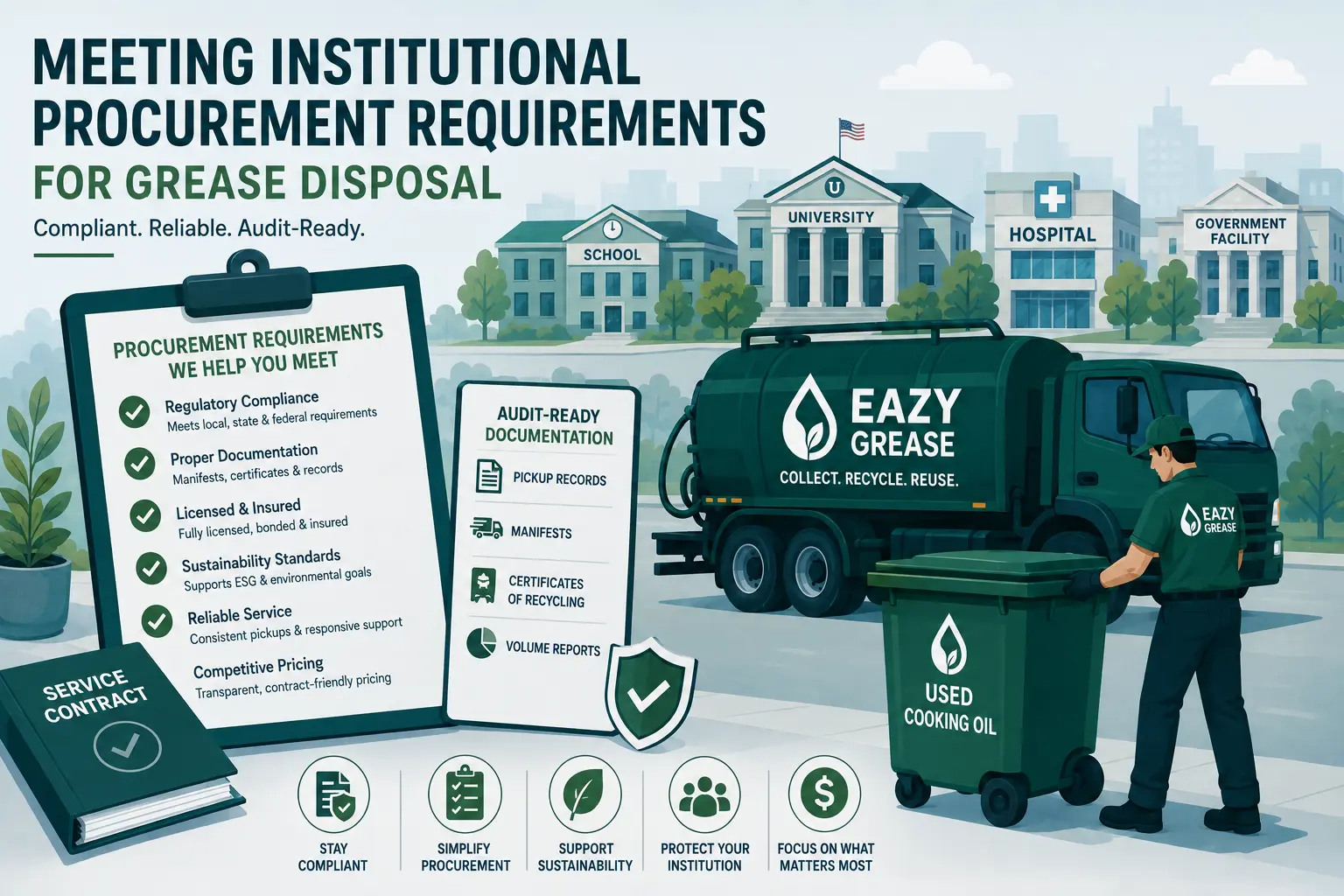
Hospitals, correctional facilities, universities, care institutions, and other large food service facilities operate under a different level of scrutiny than independent restaurants. When meeting institutional procurement requirements for grease disposal, these organizations must satisfy multiple layers of regulation simultaneously: municipal FOG programs, state environmental requirements, internal compliance audits, and vendor certification standards. Getting this right requires understanding how grease interceptors work, what best management practices apply, and how to structure documentation that holds up under inspection.
This post covers the full picture for institutional food service operators and procurement teams responsible for grease disposal compliance.
What Businesses Need Grease Traps?
Any food service establishment that produces fats, oils and grease as a byproduct of cooking is subject to FOG program requirements and must install grease interceptors or grease trap units to prevent grease-laden wastewater from entering the sanitary sewer system. This includes restaurants, cafeterias, hospitals, correctional facilities, care institutions, strip center food courts, ice cream parlors, bakeries, and any other facility preparing or serving food at commercial scale.
Class III and IV food service establishments, which are defined by higher volumes of cooking activity and grease output, must install a grease interceptor rather than a smaller under-sink trap. Institutional kitchens in hospitals, universities, and correctional facilities almost always fall into these higher classifications due to the volume and frequency of cooking operations.
New food service facilities must comply with grease interceptor requirements before discharge begins, and must notify the city prior to commencing operations. Failure to install and certify the appropriate equipment before opening is grounds for enforcement action and can delay certificate of occupancy approval.
How Grease Interceptors Work
Grease interceptors are underground or in-line systems designed to capture fats oils and grease before grease laden wastewater reaches sewer pipes. Wastewater from commercial kitchens flows through the interceptor, where the difference in density between oil and water causes fats and oils to rise and separate while food solids and other solids settle to the bottom. The clarified water then exits through an outlet tee into the sanitary sewer.
The internal structure of a grease interceptor includes a baffle wall that forces water to travel a longer path through the tank, maximizing separation time. A stub out at the inlet slows incoming flow and directs it downward to minimize turbulence. Settled solids accumulate at the bottom of the tank while the grease layer builds up at the surface.
Grease interceptor sizing is determined by the flow rate of the connected fixtures, the type of food service operation, and the applicable local code. Hydromechanical units are rated in gallons per minute, typically from 10 GPM to 100 GPM, and are suitable for moderate-volume kitchens. Gravity grease interceptors are larger units, typically 750 to 2,000 gallons or more, installed underground outside the facility and used for high-volume institutional kitchens.
Grease interceptor tanks must be readily accessible for inspection and pump-out by licensed haulers. Restricted access or improper placement that prevents a complete pump is a common compliance violation in institutional settings.
Which Fixture Is Not Allowed to Discharge to a Grease Interceptor?
Toilets, urinals, and other sanitary fixtures are not permitted to discharge to grease interceptors. The interceptor is designed exclusively to handle grease laden wastewater from food preparation and dishwashing fixtures.
The following fixtures must connect to the grease interceptor in most jurisdictions: pre rinse sink connections, pot sinks, floor drains in cooking areas, dishwashers, and other fixtures that discharge oils and food particles from food preparation. A mop sink used for kitchen cleaning may also be required to connect depending on the local FOG ordinance.
Fixtures that catch food scraps and food waste as part of normal operations, including prep sinks and pans washing stations, must route through the interceptor. However, toilets and other sanitary fixtures connect directly to the sanitary sewer and must never be routed through grease interceptor tanks.
Food grinder and garbage disposal units present a specific compliance concern. Many FOG programs prohibit connecting a garbage disposal to fixtures that discharge to a grease interceptor, because food scraps and other solids accelerate the accumulation of grease interceptor waste and require more frequent pump-outs. Some jurisdictions prohibit food grinders in commercial kitchens entirely for this reason.
What Is the Trap Required for Restaurants Discharging Large Amounts of Grease?
For food service establishments and institutional kitchens discharging large volumes of fats oils and grease, the required unit is a large-capacity gravity grease interceptor installed outdoors, underground, and connected to all grease-generating fixtures in the kitchen. These units are designed to handle the grease laden wastewater volumes that smaller hydromechanical units cannot manage without requiring daily or near-daily pump-outs.
Large institutional kitchens, such as those in hospitals, correctional facilities, and university dining halls, typically require interceptors sized to their peak flow rate with sufficient tank volume to allow quarterly maintenance cycles. The 25% Rule applies regardless of tank size: grease interceptor waste, including floating oils and fats and settled solids at the bottom, must not exceed 25% of the total tank capacity at any time. Once grease buildup approaches that threshold, a complete pump is required.
Some jurisdictions require active grease recovery units for the highest-volume food service facilities. Active Grease Recovery Units must be maintained per manufacturer recommendations and may require more frequent servicing than standard passive interceptors.
How Should Grease, Fat, and Oil Be Disposed Of?
Proper grease disposal for institutions requires understanding the difference between yellow grease and brown grease, and handling each through the correct channel.
Yellow grease is used cooking oil drained from fryers and collected in above-ground storage containers. Yellow grease has commodity value and can be sold to licensed rendering companies or used cooking oil collection services that recycle waste cooking oil into biodiesel, renewable diesel, and other products. Institutions should never pour grease from fryers into floor drains or sanitary sewer connections. Yellow grease must be stored in sealed containers and collected by a licensed hauler.
Brown grease is the grease interceptor waste pumped from grease trap and interceptor tanks during maintenance. Brown grease contains a mixture of fats, oils, food particles, water, and other solids that have separated over time in the tank. Only licensed grease haulers are permitted to remove and transport grease trap waste, and collected grease must be transported to permitted disposal facilities. Institutional facilities must contract only with licensed rendering companies for brown grease removal.
Records of grease removal services must be stored on-site for three years. Facilities must keep a Service Manifest for all grease collections, documenting the date of service, the volume removed, the license number of the hauler, and the destination facility. These records must be maintained on-site and made available to inspectors on request.
Food waste and food scraps must be disposed of in trash cans, not down sinks or floor drains. Pouring grease, oils, or fats into the sanitary sewer, whether through a sink, floor drain, or mop sink, contributes to grease blockages in sewer pipes, sanitary sewer overflow events, and raw sewage backups that create public health emergencies.
FOG Program Requirements for Institutional Operators
Most municipalities operate a formal FOG program that establishes the rules, fees, certification requirements, and enforcement mechanisms for grease disposal compliance. Institutional food service operators must understand and comply with the FOG program in every city where they operate.
Annual fees. In some cases, food service establishments must pay a $150 annual fee in many jurisdictions to maintain their wastewater discharge permit under the local FOG program. Fee amounts vary by city but the requirement to register and pay is standard across most FOG ordinances.
FOG certified employee. Each food service establishment must have at least one FOG certified employee on staff. FOG certification training helps ensure compliance with local sewer regulations and prevents sewer backups from improper grease disposal. FOG certification training is available for free in some jurisdictions, including Virginia Beach, and is offered through municipal utility authorities and wastewater treatment agencies in most major cities.
Maintenance records. Food service establishments must maintain a cleaning log for grease traps and grease interceptors, documenting every service visit, the name and license of the hauler, the volume pumped, and any maintenance performed on the unit. Maintenance records must be kept on-site and available for inspector review.
Quarterly servicing. Grease interceptors must be maintained quarterly at minimum, with outdoor grease traps emptied every three months. Kitchens with higher output may require more frequent pump-outs to stay below the 25% Rule. The FOG program in most jurisdictions requires a certified FOG hauler to perform all pump-outs and grease trap waste removal.
Enforcement. Non-compliance with the local FOG program can result in enforcement action including fines, permit suspension, and in serious cases, sewer service disconnection. New facilities must comply with all FOG program requirements before discharge begins.
Best Management Practices for Institutional Grease Management
Beyond the minimum regulatory requirements, best management practices for institutional food service facilities reduce the frequency of pump-outs, extend equipment life, and lower overall grease management costs.
Dry wipe before washing. Train kitchen staff to dry wipe pans, dishware prior to washing, and other cooking surfaces with a paper towel or oil absorbent material before placing them in the pre rinse sink or dishwasher. Removing fats and oils before they enter the wastewater stream reduces the load on grease interceptors and slows the rate of grease buildup between services.
Never pour grease down the drain. Staff should never pour grease or oils from pans or cooking vessels into a sink, floor drain, or mop sink. All liquid fats and oils must go into designated collection containers. This is one of the most important management practices in any food service operation and is the single most effective way to prevent sanitary sewer backups caused by grease blockages.
Avoid biological additives. Using biological additives or enzyme treatments to emulsify grease is generally prohibited under most FOG programs. These products break grease into smaller particles that pass through the interceptor and create build up further down sewer pipes, shifting the blockage problem rather than solving it. Biological additives do not substitute for proper mechanical cleaning of grease interceptor tanks.
Catch food scraps before they reach the drain. Use sink strainers and basket inserts in pre rinse sink and pot sink connections to catch food scraps and food particles before they enter the drainage system. Food solids that bypass the interceptor accumulate in sewer pipes and contribute to grease blockages over time.
Use hot water correctly. Hot water is sometimes used to flush grease through drain lines in the mistaken belief that it dissolves grease permanently. Flushing grease with hot water moves it through the interceptor but allows it to re-solidify further down sewer pipes, where it creates build up that is harder to access and more expensive to remove. Hot water should be used for washing dishware and equipment, not for flushing fats and oils down the drain.
Schedule pump-outs proactively. Do not wait until grease interceptor waste reaches the 25% Rule threshold before scheduling a complete pump. High-volume institutional kitchens should track grease levels between services and schedule pump-outs proactively to stay well below the compliance threshold.
Yellow Grease and UCO Collection: The Other Side of Institutional Grease Management
While brown grease management falls under grease trap and interceptor maintenance, yellow grease, the used cooking oil produced by fryers and cooking equipment, is managed separately. Institutions that recycle waste cooking oil through a licensed UCO collection partner not only stay compliant with disposal regulations but also convert a waste product into a revenue stream through rebate programs.
Proper separation of yellow and brown grease is a regulatory requirement in most jurisdictions. Yellow grease stored in sealed above-ground containers for collection is handled differently from grease interceptor waste removed during pump-outs. Mixing the two streams or disposing of yellow grease through the interceptor creates compliance violations and degrades the value of both materials.
For institutions across the East Coast, Eazy Grease provides licensed used cooking oil collection, free storage containers, and digital service documentation at every pickup, supporting the yellow grease side of institutional FOG compliance across Florida, Georgia, Alabama, Tennessee, South Carolina, North Carolina, Pennsylvania, Connecticut, New Jersey, and New York. Visit eazygrease.com to set up a collection program for your facility.